Amaralingeshwara Kona is finished. The last thing we did was lay the cement floor at the Kamakshi Amma shrine, and everything below is how it got there.
Amaralingeshwara Kona is a temple in the forest, in the hills north of Tirupati. People could barely get to it. There are two shrines there now, Rama Lingeshwara Swamy and Kamakshi Amma, and we built both. I had an aeronautical engineering degree and no experience of construction, roads or stone.
The ground came first
We built the ground before we built the road. Where people stand now was a pit of loose rock and trees, and we cut the trees, threw in six or seven feet of rock and covered it with red soil until it was flat enough for a few hundred people to sit on. Then the steps up to it, laid from rock, with the two hundred bags of sand I spent three months carrying in.
Why I did it
People ask why I did it. The belief came first. I had it before I ever went up there, and it is what took me to that temple. It did not arrive afterwards because of something that happened there. Nothing forced me into this. There was no crisis behind it and nothing I was trying to fix, and an aeronautical engineering degree is no reason to spend three months carrying sand into a forest. I have never doubted what is there, and I did not doubt it on any day of the work. That is the whole of the reason.
The Lingam nobody came for
No shrine was in the plan, and no deity. Somebody had thrown a Shiva Lingam into the forest and left it. I watched it for months, and when nobody came for it I moved it up to the flat ground we had made. That is Rama Lingeshwara Swamy.
Then the water took the path
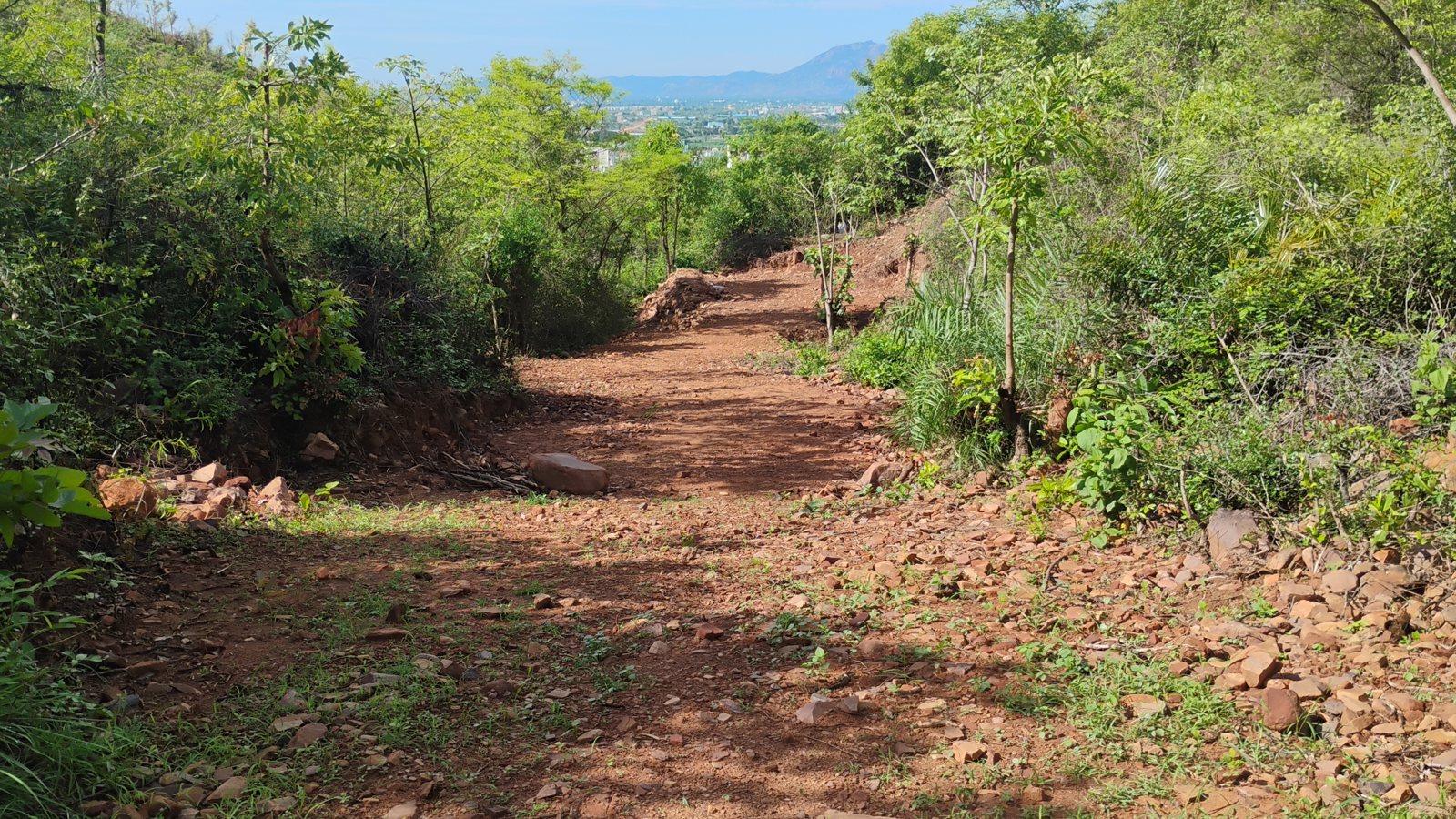
Nobody had thought about a road until the water took the path out. I was not there that day. Somebody sent me the picture of it. We started on the road because a vehicle could not get within half a kilometre of the place. We cleaned the entrance, cut the trees back so you could see what was ahead of you on the turns, and took the grass and the stone out by hand.
Rock, and a bridge we could afford
Most of the work after that was water. Rain had torn a hole out of the path and we filled it with rock carried in from a distance. There was a drop you had to climb down into, so we filled that too. A check dam was sitting low with trees growing in it, and we raised it and sent the water the other way. At the crossing on the turn we built a bridge out of blocks of about half a tonne each, because cement was out of reach.
What it cost
I never had the money for any of this in hand. It came to five or ten lakhs of rupees and I do not know the exact figure. The cement for the steps we borrowed and asked people for. The rest I had to find. Paying it back is mine to do. Whatever I was earning went into it: fifteen thousand a month at first, then forty. A friend who believes in Shiva sent ten thousand a month, because he thought the work was right. Nobody was ever on a wage. My friends, my brothers and my relatives did the work.
Kamakshi Amma, last
Kamakshi Amma came last and I did not plan her either. The ground was eight feet below where it needed to be. We raised it, put steel posts in concrete, roofed it, and installed her in November 2024. The cement floor under her, in 2025, was the end of it.
Steps up the hill and a platform raised six feet out of rock. Half a kilometre of road. A stone bridge at the crossing. The hole the rain tore out of the path, filled with rock carried in. The drop you had to climb down into, filled as well. A check dam raised, and the water sent the other way. Two shrines with a deity in each, Rama Lingeshwara Swamy and Kamakshi Amma.
None of this was written on the day. The dates come off the cameras, and where a camera disagreed with what I remembered, the entry says so.
Oldest first
I want you to see it the way it was, because nothing after this means much otherwise.
Bhoomi Pooja at Amaralingeshwara Kona, on Varalakshmi Vratham
We did the Bhoomi Pooja on Varalakshmi Vratham, before any construction, and asked for the work ahead to go well.
Cement steps up the hill, after three months carrying sand
The path was uneven stone and people slipped on it.
Then the rain came and took the way in.
I threw a stone and told Shiva I was starting
For a year after the steps I did nothing at the temple.
The whole of the first year went on the water and the ground
People assume the road came first.
A discarded Shiva Lingam installed, on Ayodhya Rama Pratishta day
Before any of this we raised the ground six feet.
The first Mahashivaratri of Rama Lingeshwara, with the whole path lit
Six weeks after we installed him, Mahashivaratri came, and it was the first one anybody had spent with Rama Lingeshwara Swamy there.
Filling the hole, then the bridge, then the road
This is where the rain had done its damage, and putting it right took two separate pieces of work.
Kamakshi Amma, from six feet below the ground to a shrine
I did not plan this one either.
Kamakshi Amma installed, three years and three months after the Bhoomi Pooja
Three years and three months after the Bhoomi Pooja, Kamakshi Amma went into her place.
A cement floor at the Kamakshi Amma shrine, and that was the end of it
We laid the cement floor under Kamakshi Amma, and that was the end of it.
- sriamaralingeshwaraswamykona.in →the older record, up since 2024
- The photographs, horizontal →190 frames, dates intact
- The photographs, vertical →98 frames